Which Is Better for Your Creek County Estate?
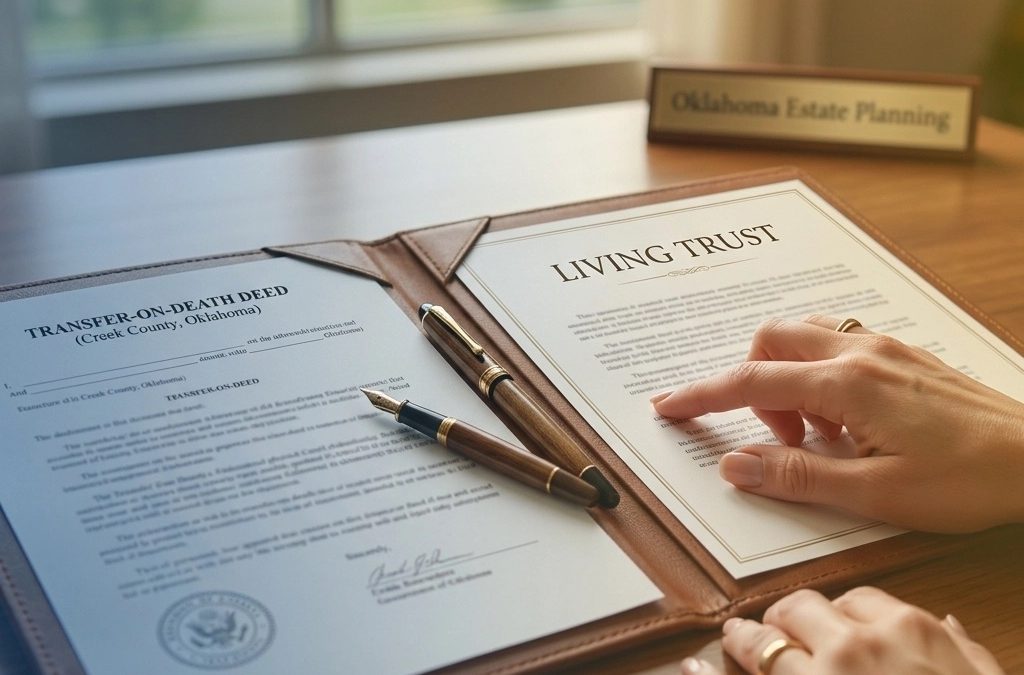
You may be asking yourself, “How can I make sure my home goes to my kids without the headache of probate court?” It is a common concern for families here in Sapulpa and throughout Creek County. When you start looking into estate planning, two options usually rise to the top: the Transfer-on-Death (TOD) deed and the Living Trust.
At first glance, they might seem to do the same thing. Both allow you to pass property to your loved ones without going through the public, often expensive process of probate. However, while they share a common goal, they work very differently in practice. Choosing the wrong one for your specific situation could leave your family facing complications you never intended.
The truth is, there isn’t a “one-size-fits-all” answer. The right choice depends on the size of your estate, the types of assets you own, and how much control you want to maintain over those assets after you are gone. As an oklahoma estate lawyer, I often help clients weigh these two powerful tools to find the perfect fit for their legacy.
What is an Oklahoma Transfer-on-Death (TOD) Deed?
Think of a TOD deed as a “beneficiary designation” for your real estate. You likely already have something similar on your life insurance policy or your 401(k). In Oklahoma, the law allows you to sign a deed that names a beneficiary who will automatically take ownership of your property when you pass away.
The most important thing to understand about a TOD deed is that it has no effect while you are alive. You still own the home completely. You can sell it, mortgage it, or change the beneficiary at any time as long as you are mentally competent. The deed only “triggers” at the moment of your death.
The Benefits of a TOD Deed
- Affordability: Generally speaking, a TOD deed is much cheaper to prepare and record than a full living trust.
- Simplicity: It is a straightforward document that focuses on one thing: your real estate.
- Avoids Probate: If the deed is drafted and recorded correctly, your home will bypass the Creek County probate court entirely.
- Easy to Change: If you decide you want to leave the house to someone else, you simply record a new deed or a revocation.
The Drawbacks of a TOD Deed
- Limited Scope: It only covers real estate. It does nothing for your bank accounts, vehicles, or family heirlooms.
- No Incapacity Planning: If you become mentally incapacitated due to illness or injury, the TOD deed doesn’t help. Someone would still likely need to go to court to gain guardianship to manage your affairs.
- Beneficiary Issues: If your named beneficiary passes away before you, or if you name multiple beneficiaries who can’t agree on what to do with the house, things can get messy very quickly.

What is a Living Trust?
While a TOD deed is a single-purpose tool, a Living Trust is more like a comprehensive “bucket” for your life’s work. When you create a trust, you (the Grantor) move your assets, your home, your bank accounts, your investments, into the trust. You usually name yourself as the initial Trustee, meaning you keep full control over everything just as you did before.
The primary difference is that the trust survives you. You name a “Successor Trustee” (often an adult child or a trusted friend) who steps in to manage or distribute the assets according to your exact instructions when you pass away or if you become unable to manage things yourself.
The Benefits of a Living Trust
- Total Asset Coverage: A trust can hold almost anything, real estate, business interests, bank accounts, and personal property. This provides a central “hub” for your entire estate.
- Incapacity Planning: This is a major advantage. If you are diagnosed with dementia or suffer a stroke, your Successor Trustee can step in and pay your bills and manage your property without seeking a court order.
- Privacy: Probate is a public record. Anyone can see what you owned and who got it. A trust is a private document.
- Controlled Distributions: Unlike a TOD deed, which hands the keys over immediately, a trust allows you to set rules. For example, you can specify that a child receives their inheritance in stages (e.g., at age 25, 30, and 35) rather than all at once.
The Drawbacks of a Living Trust
- Higher Initial Cost: Because it is a much more complex and powerful legal document, it costs more to set up than a simple deed.
- Maintenance: You must “fund” the trust. This means changing the titles on your accounts and recording deeds to move property into the trust’s name. If you don’t fund it, the trust is just an empty bucket.
Why Creek County Families Often Choose a Trust
When clients visit our office in Sapulpa, they often start by asking for a “simple” fix. However, once we dig into the details of their lives, the limitations of a TOD deed become clear.
For example, if you own a home in Sapulpa but also have a farm in Bristow and several investment accounts, managing all of that through individual beneficiary deeds and “Payable on Death” forms is a logistical nightmare. Oklahoma estate attorneys often recommend a trust in these cases because it simplifies the process for your grieving family. Instead of chasing down different forms for different assets, your Successor Trustee has one set of instructions to follow.
Furthermore, we cannot ignore the fact that many of us will face a period of incapacity before we pass away. If you only have a TOD deed, your family may be forced into a “Guardianship” proceeding at the Creek County Courthouse just to sell your home to pay for your care. A Living Trust avoids this stress and expense entirely.
You can learn more about why this matters on our Estate Planning FAQ page.

Comparing the Two: A Quick Glance
Can You Use Both?
It is a popular misconception that you have to choose one or the other. In some very specific cases, an oklahoma estate lawyer might use both tools as part of a strategy. However, generally speaking, if you have a Living Trust, you do not need a TOD deed. You simply deed the property into the trust itself.
If you already have a TOD deed and later decide to create a trust, it is vital to update your deed. In Oklahoma, the most recent validly recorded document usually takes precedence, but leaving conflicting documents on file is a recipe for a legal dispute after you are gone. This is why working with Creek County attorneys who understand local filing requirements is so important.
Which One is Right for You?
So, how do you decide? Generally speaking, a TOD deed might be the right choice if:
- Your home is your only significant asset.
- You are on a very tight budget and just want to make sure the house stays out of probate.
- You have a single, adult beneficiary who is financially responsible.
On the other hand, a Living Trust is almost certainly the better option if:
- You own multiple pieces of real estate.
- You have minor children or grandchildren you want to provide for.
- You want to ensure you are taken care of if you become ill or incapacitated.
- You want to keep your family’s financial business private.
If you are dealing with other complex issues, such as a recent divorce or a potential bankruptcy, the choice becomes even more critical. You can explore how these intersect on our divorce or bankruptcy pages.

Taking the Next Step for Your Family
Planning for the future can feel overwhelming, but it is one of the greatest gifts you can give your family. By deciding now between a TOD deed and a Living Trust, you are saving your loved ones from the stress of probate and ensuring your wishes are respected.
Whether you are in Sapulpa, Kellyville, or anywhere else in the area, our team is here to help you navigate these choices. We believe in providing clear, straightforward legal advice that makes sense for your life and your budget.
You’re invited to reach out to us to discuss your specific needs. We can help you build a plan that protects your assets and provides peace of mind for years to come.
Ready to protect your legacy? Contact Gene Thompson, Attorney at Law today for a consultation.